
Every quarter, a stack of retail market reports lands in my inbox. Most people skim the headline and move on. This quarter I read six of them side by side: Baker Tilly, CBRE, Cushman & Wakefield, Colliers, Marcus & Millichap and JLL.
Here's my verdict in one line. Retail real estate is tight, steady and in better shape than almost any other property type, but the margins underneath it are thinner than the headlines suggest.
I've spent more than 30 years on the tenant side of this business. I've helped open over 900 stores for chains like Sprouts, Staples, Rubio's, The Fresh Market and Action. I've sat in a lot of real estate committee meetings where a rosy market report met a hard pro forma. So when every report says retail is "resilient," my first question is always the same. Resilient for whom?
Let's dig in.
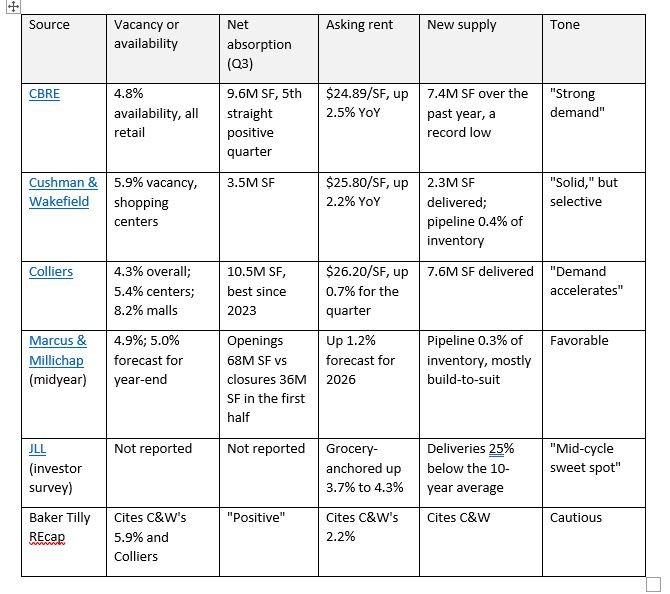
The scoreboard
On the basics, the six reports tell the same story: vacancy between 4.3% and 5.9%, positive demand, and almost no new supply. The numbers differ mostly because each firm measures a slightly different slice of the market.
Where everyone agrees
1. Supply is the whole story. Nobody is building retail. CBRE counted 7.4 million square feet delivered over the past four quarters, the lowest on record. Marcus & Millichap says the entire national pipeline is about 0.3% of existing space. Construction costs are up 4.45% in the past year, and financing costs more than it did before the pandemic. Rents haven't kept up, so a new shopping center rarely pencils unless most of it is preleased before the first shovel goes in. Richmond, Virginia is a good example: 379,000 square feet under construction, and 74% of it already leased.
When nothing new gets built, the old space fills up. That's the engine behind every positive number in these reports.
2. Demand picked up in Q3. CBRE recorded 9.6 million square feet of net absorption, its fifth straight positive quarter. Colliers had 10.5 million, its best since 2023. Marcus & Millichap found that store openings outran closures almost two to one in the first half of the year. Retailers who want to grow are taking whatever good space they can find.
3. The same tenants keep showing up. Every report names the same winners:
• Grocery. JLL found that 81% of retail investors want grocery-anchored centers in their plans.
• Discount and off-price. Cushman & Wakefield counted 1,046 discount store openings and 214 off-price apparel openings so far this year.
• Fitness and services. Colliers says fitness concepts "consistently outperformed" on foot traffic.
• Quick-service restaurants, especially in busy suburbs.
These are needs-based, value-based and traffic-based uses. People still need groceries, still hunt for a deal, and still want to get out of the house. None of that changes much when the economy wobbles.
The number nobody puts in the headline
Rents are rising more slowly than inflation. CBRE has asking rents up 2.5% from a year ago. Cushman & Wakefield has 2.2%. Colliers reported 0.7% for the quarter, and Marcus & Millichap forecasts 1.2% for the full year. Meanwhile, headline inflation was running at 3.7% in September.
Do the math. In real terms, the average landlord's rent is flat to slightly down.
That doesn't square with the most common line in these reports, which is that tight supply gives landlords leverage. It does, in the best trade areas. A pad with a national tenant in a growing Phoenix suburb is getting close to $60 a foot. But across the broad middle of the market, landlords are raising rents about as fast as they can without losing tenants, and it isn't fast enough to keep pace with their own costs.
The consumer picture has the same wrinkle. Baker Tilly cites retail sales up 6.0% from a year ago, but only 3.4% excluding gas stations. With prices up 3.7%, shoppers are spending more dollars to buy about the same amount of stuff. That's not a collapse. It's a treadmill.
Baker Tilly makes the right point here: look at tenant sales and occupancy cost, not just whether the space is leased. A center can be 95% full while half its tenants are quietly struggling to pay the rent.
Where they disagree
1. The money. This is the big one. The brokers are upbeat about the investment market. JLL calls it a "mid-cycle sweet spot," with buyers outnumbering sellers and the number of lenders quoting retail deals up 115% from the low. Marcus & Millichap says retail deal volume is growing faster than any other property type.
Baker Tilly reads the same quarter very differently. It says capital markets "deteriorated rapidly" late in the quarter, warns that loans written at 3% now have to refinance at 5.5% to 7%, and closes with this line: "the seas appear stormier as we approach the end of the year than one would have envisioned earlier in 2026."
Who's right? The numbers lean toward Baker Tilly. CBRE's own data shows Q3 retail investment at $16.8 billion, down 6% from a year ago. Newmark's capital markets business was the only part of the company that shrank in the third quarter, and management blamed high rates for keeping owners from selling.
It's worth remembering who's talking. Brokers earn their living when properties trade, so they tend to see the glass as half full. Baker Tilly does valuations and audits for a living. It gets paid to find the problem. I'd read the brokers for the market data and Baker Tilly for the risk.
2. Malls. Baker Tilly says lower-tier malls will keep struggling, and that's true. But the best malls are doing better than you'd think. CBRE says lifestyle centers and malls had the biggest drop in availability of any format this quarter. Colliers reported mall vacancy down to 8.2% and department store visits up 5% to 12% a month. The mall isn't dead. The B and C mall still is.
3. Store closures. Baker Tilly treats closures as a risk with a silver lining. The other reports put numbers on it, and they're encouraging. Marcus & Millichap found 68 million square feet of openings against 36 million of closures in the first half. When a chain shuts down, there's usually someone in line for the space. The real question is how long the box sits dark and how much it costs to fill.
A look at my backyard: Phoenix
Phoenix is a good example of the national story, with a twist. Colliers lists it among the top five metros for retail under construction, alongside Dallas-Fort Worth, Houston, Austin and Chicago. That sounds like a warning sign until you look closer.
• It's almost all spoken for. Marcus & Millichap expects about 2.8 million square feet of new retail here this year, and nearly 90% of it is already committed. Groundbreakings in the first half hit a five-year low.
• Demand is picking up. CBRE recorded 642,000 square feet of net absorption in Q3, up from 441,000 in Q2. Availability slipped to 4.4%.
• Rents are mixed. The average asking rent dipped 21 cents to $20.43, while small pads with national tenants are near $60 a foot. The gap between the best space and the rest is wide.
• Investors are pausing. Retail sales volume fell to $293 million from $458 million in Q2.
Phoenix grows the way it always has: out. Most of the new space is small pads and big power centers on the edge of the metro, following the rooftops. If you're a retailer here, the fight is over the right corner in a growing suburb, and there aren't many of them.
What it means for you
If you're a retailer trying to grow:
1. Good sites are scarce, so move early. With almost nothing new being built, the best second-generation space gets leased before it hits the market. The chains winning right now have their site criteria, sales model and approvals ready before the broker calls.
2. Expect landlords in strong centers to hold firm. Plan for tougher renewals and less room on rent, especially where your current lease is below market.
3. Don't overpay in the weaker centers. Landlord leverage is real in the top trade areas, but not across the board. Outside the A centers, rents are barely moving, and tenants still have options.
4. Know your occupancy cost ratio cold. When a landlord pushes on rent, your answer should be a number, not a feeling.
If you own a center with a dark box:
1. Your next tenant is probably on a short list. Grocery, discount, off-price, fitness and services are the users still opening stores and able to take big space.
2. Budget for the work. Subdividing an anchor box is expensive and slow. The landlords who fill boxes fastest know their re-tenanting costs before the first tour.
3. Merchandising matters as much as the box. A center with a tired facade and a weak tenant mix will sit vacant longer, no matter how tight the market is.
If you're an investor:
1. Grocery-anchored is crowded for a reason. JLL found 81% of investors want it. That pushes prices up and returns down.
2. The upside is in repositioning. The quarter's biggest deals, like Plaza Bonita in National City and The Shoppes at Chino Hills, were bets on fixing a center, not just holding one.
3. Underwrite the refinance, not just the purchase. If your returns only work when rates fall, they don't work. Plan for today's rates and treat a cut as a bonus.
Over 900 store openings, I learned one lesson the hard way more than once. A great market doesn't save a bad site, and a tough market doesn't sink a great one. These reports describe the market. Your results come down to the specific corner.
The bottom line
Retail real estate is in a strange and fairly good spot. For 15 years, the story was too much space and dying malls. Now the story is not enough space and nobody building more. That's a real shift, and it's good news for owners of well-located centers and for retailers with a disciplined plan.
But "tight" isn't the same as "strong." Rents are trailing inflation, shoppers are running in place, and the money that buys and refinances these properties just got more expensive. Two of those three risks won't show up in a vacancy rate until it's too late.
So read the headline, then read the footnotes. And when someone tells you the market will carry a deal, ask them which corner they're talking about.
If you're working through a growth plan, a dark box or a tough renewal, I'm always happy to compare notes.
Sources
• Baker Tilly, REcap: Q3 2026 Real Estate Report
• CBRE: Q3 2026 U.S. Retail Market Report
• Cushman & Wakefield: U.S. Retail Demand Remains Solid as Limited Construction Keeps Space Tight
• Colliers: U.S. Retail Demand Accelerates as Consumers Remain Selective
• JLL: 2026 U.S. Retail Thematic Outlook and Investor Survey
• Marcus & Millichap: U.S. Retail Real Estate Outlook 2026
• Commercial Observer: Newmark Revenue Up Despite Capital Markets Slump
• CBRE: Phoenix Retail Figures Q3 2026
• In Business Magazine: Phoenix Retail Demand Leads U.S. with 90% of New Space Committed