
Bottom line
I just got done studying the 2026 Axonify Grocery Consumer Survey. From where I sit as a consultant, this survey confirms what grocers feel but rarely say out loud. Price is the cost of entry. Execution is the product. Shoppers are angry about prices, and that anger has made them less forgiving of operators, not more.
That will shape how grocers grow over the next three to five years. I expect fewer, better-chosen new stores; more capital going into existing stores; tighter format discipline; and site selection that weighs whether a store can execute as heavily as its demographics.
The grocers that read this correctly will treat today's switching as the best window to gain share in a decade. Those that respond to price pressure by cutting store labor will hand that share to them.
What the data supports, and its limits
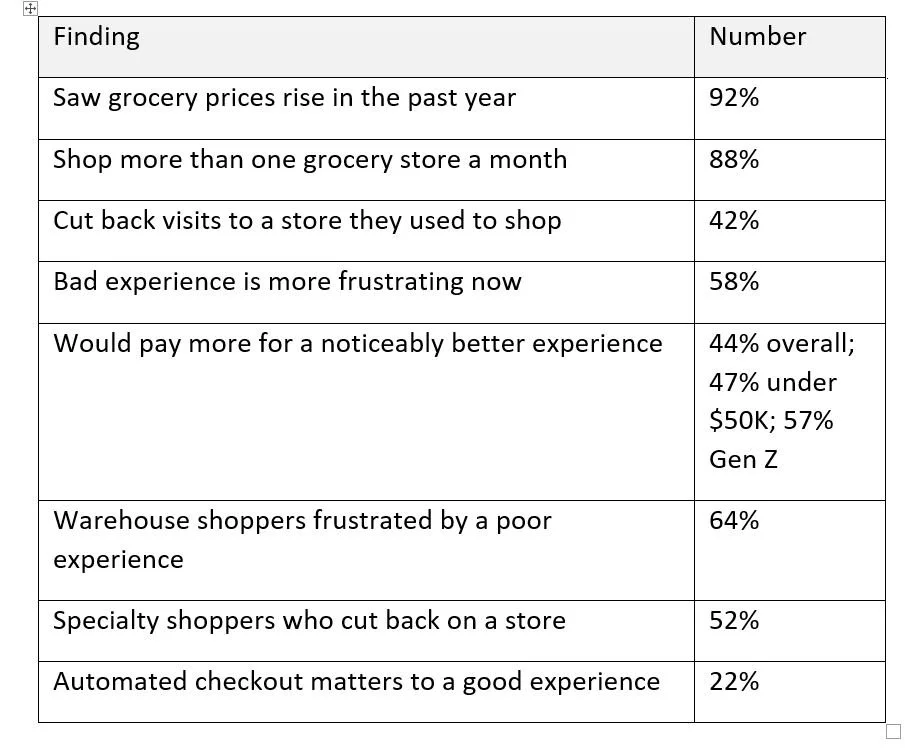
The headline numbers are solid enough to quote. The survey covered 1,251 U.S. and Canadian shoppers from July 30 to August 5, 2026, weighted on seven demographic variables, with a credibility interval of plus or minus 4 points.
Four cautions before putting it in front of a committee:
• The source sells the answer. Axonify sells frontline training software, so the conclusion that staff execution matters most is also its sales pitch.
• Willingness to pay is what people say, not what they do. Treat 44% as a signal, never as a sales assumption.
• The driver analysis is correlation. The report itself says shared variance (about 21% to 24% per staff factor) does not mean cause.
• Format subsamples are smaller. Splits by format, income and generation carry wider error than the plus or minus 4 points on the full sample.
What I see in the market
Grocers are caught in a three-way squeeze. Product costs are up. Labor is expensive and hard to keep. Shoppers are watching every price. The easy move is to protect margin by trimming store hours, staffing and maintenance.
This survey shows why that move backfires. The things that suffer first when labor gets cut are the things shoppers now notice most:
• Lines get longer when checkout isn't staffed for the peak
• Shelves go empty when there aren't enough hands to restock
• Stores look tired when cleaning and maintenance get deferred
• Nobody is around to answer a question
Anyone who has sat on a real estate committee knows that growth money and store money compete for the same capital. This survey is a strong argument that, right now, the existing store deserves its share before the next new one gets approved.
The other thing I see: 88% of shoppers already spread their trips across more than one store. That makes the market more fluid. Fluid markets reward operators who show up well run, in the right place, with the right format.
How the data will shape grocery growth decisions
1. Remodels move up the list. If a tired store loses shoppers who are already willing to switch, a remodel defends sales that a new store can't. Expect more capital plans to fund the existing fleet first, and more committees to ask "what does this do to our nearby store?" before approving a new one.
2. New stores get fewer and more selective. Growth won't stop, but the bar goes up. Grocers will favor sites where they can win share from weaker operators, not just sites with good demographics. The question shifts from "is there enough population?" to "who here is executing poorly, and can we take their customers?"
3. Competitor quality enters the forecast. Most sales forecasts treat every competing store inside a radius about the same. This data says a poorly run competitor is a share opportunity and a well-run one is a wall. Smart growth teams will grade competitors on condition, staffing and in-stocks, not just count them.
4. Cannibalization gets more scrutiny. When shoppers move easily, a new store pulls harder from the chain's own nearby stores. Expect committees to challenge light transfer assumptions.
5. The box spec becomes a growth decision. Back-of-house space, receiving, checkout frontage, refrigeration and parking all decide whether a store can deliver the experience shoppers now judge. Grocers will walk away from cheap boxes that can't support execution.
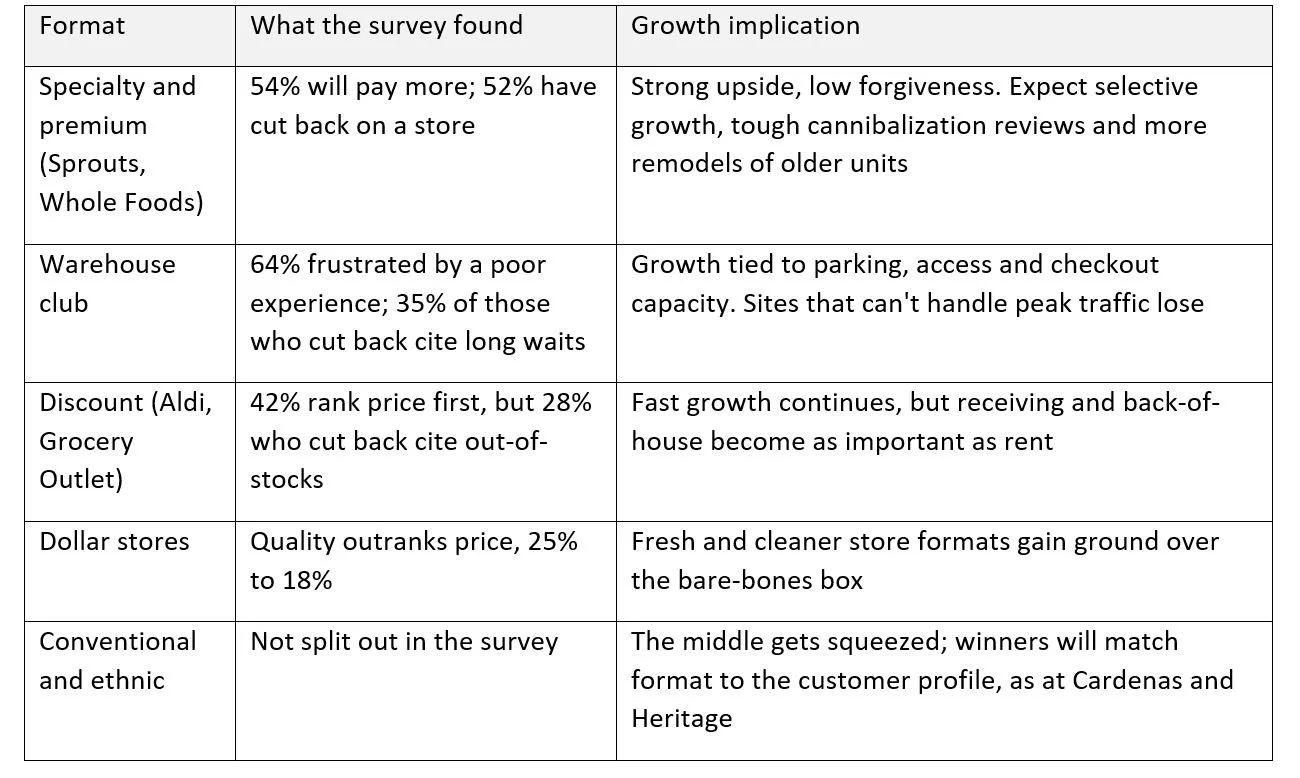
6. Customer profile beats radius demographics. Gen Z, Gen X, budget households and specialty shoppers each want different things. Matching format to the actual customer, as I did at Cardenas, matters more than income and population counts alone.
7. Opening execution carries more weight. Shoppers judge a new store fast and switch easily. Delivery dates, turnover condition and time to hire and train before opening become part of the site decision, not an afterthought.
How grocers will respond to consumer sentiment
Sentiment is sour on price, but the survey shows shoppers are judging the whole trip. I expect the smart responses to fall into four groups.
Defend price perception without gutting the store. Expect more private label, sharper promotions on visible staples and loyalty pricing. The cost savings will come from places shoppers can't see: supply chain, energy and back office. Labor on the sales floor is the last place to cut.
Run the fundamentals as daily metrics. In-stock rates, checkout wait times, cleanliness and freshness will move from occasional audits to daily scorecards. The survey's own advice says the same, and it matches what drives shopper ratings.
Put people back in front of the shopper. Friendly, knowledgeable and available staff are among the strongest drivers of shopper ratings. Self-checkout matters to only 22% of shoppers. Technology will keep growing, but as a tool to free staff for the floor, not to replace them.
Earn the next generation now. Gen Z picks stores on experience, and its spending power is growing. Grocers that win those shoppers early can keep them for decades. That favors fresh, clean, easy-to-shop formats in the places younger households are forming.
The grocers that respond only with price cuts will be in a race to the bottom with Walmart, Aldi and the clubs. The ones that respond with execution will hold their customers at a fair price.
What it means by format
Each format makes a different promise, and shoppers leave when that promise breaks. That will push each format's growth plans in a different direction.
What it means for landlords and developers
Grocers' growth choices land directly on shopping center owners. Three shifts to plan for:
• Dark grocery boxes are easier to fill than they look. With 42% of shoppers already pulling back from a store, a vacant box in a good trade area is a share opportunity for the right grocer. The pitch should name the weak competitors nearby, not just the demographics.
• Tenants will ask more of the building. Expect tougher work letters on slab, HVAC, refrigeration, receiving, storefront and parking. Owners who price that work early and know which items a tenant won't trade away will close faster.
• Grade your grocer, not just its rent. A grocer that is cutting labor and letting the store slide is a vacancy risk long before it misses a payment. Execution is now an early warning sign for the whole center's traffic.
Where I help
After 40+ years on the tenant side, the questions I bring to a grocery growth plan line up with what this survey says shoppers care about:
1. Should this capital go to a new store, or to the existing store down the road?
2. Who in this trade area is executing poorly, and can we take their customers?
3. Does the format match the actual customer, not just the income and population counts?
4. Can this box support great execution: receiving, refrigeration, checkout and parking?
5. Are the transfer and cannibalization assumptions realistic for shoppers who switch this easily?
6. Does the lease protect our ability to run a great store for the full term?
That work is available on a flexible basis, as a fractional deal maker or fractional CDO for grocers and growing chains, or as a tenant-side diagnostic for landlords and developers.
One caution on using this survey: it comes from Axonify, which sells frontline training software. Its core numbers (88% shopping multiple stores, 42% cutting back on a store) are solid. Its willingness-to-pay figures are what shoppers say, not what they do. Use it to frame the problem, not to prove a sales number.
Grocers can't control inflation. They can control where they grow, what they build, and how well they run the store once the doors open.