
Executive summary
Sprouts' moat was never organic produce. It was organic produce at a price the conventional supermarket shopper could say yes to. In 2020, Sprouts traded that position for margin, and in 2026 the bill came due.
I was in the room for the first half of this story. From 2012 to 2020 I built the Sprouts development function and opened 239 stores as Chief Development Officer. Several more of my deals opened after I left. Every one of those sites rested on one promise: "Healthy Living for Less."
The argument of this post, in five points:
1. The moat was value leadership. The 2013 IPO prospectus said produce was priced below conventional grocers and "even further below" high-end natural retailers, and that the weekly ad targeted "the everyday supermarket shopper."
2. The model was a conversion engine. Cheap produce brought in trial shoppers. Education and promotions turned them into lifestyle customers who shopped the whole store.
3. In 2020, Sprouts walked away from it. New leadership cut commodity promotions and said it was willing to lose price-driven shoppers.
4. It worked, for a while. Margins and earnings hit records by 2024. That is the strongest case against my view, and I take it seriously below.
5. The weakness has now reached the core. In October 2026, transactions fell 3.3%, Bank of America downgraded the stock to Underperform, and Sprouts announced price cuts on produce and meat. The company is reaching back for the lever it gave up.
My conclusion: in grocery, a price position on the categories that drive trips is a durable asset. A margin gain built by surrendering it is a loan, not a profit.
Sprouts strategy timeline · 2013 to 2026
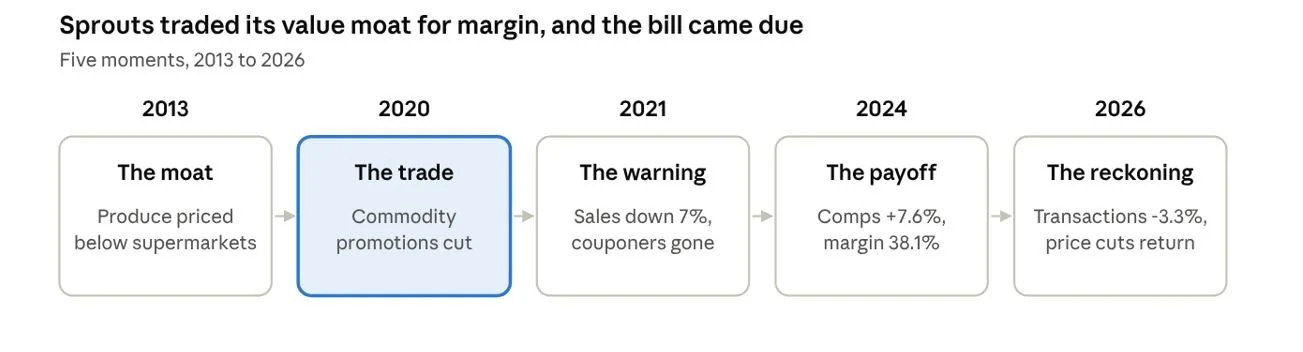
The 2020 decision, highlighted, is the hinge: four strong years followed, then the customer base it narrowed began to give way.
2013: the moat, in the company's own words
The 2013 IPO prospectus is unusually clear about where the advantage came from. Value is not one strength among many. It is the foundation.
Price was positioned against two rivals at once. Three separate times, the prospectus said Sprouts priced produce "significantly below those of conventional food retailers and even further below high-end natural and organic food retailers." Cheaper than Kroger and Safeway. Cheaper still than Whole Foods.
The conventional shopper was the target. The company said it drove traffic "by aggressively promoting produce and other items through weekly advertisements designed primarily to reach the everyday supermarket shopper." It also said, "the majority of our customers are initially attracted to our stores by our fresh produce."
The engine had three gears:
Trial - What the customer does - Shops one department, usually produce
Trial - What moves them along - Produce priced below the supermarket
Transition - What the customer does - Starts trying other departments
Transition - What moves them along - Promotions, signage, staff education
Lifestyle - What the customer does - Makes Sprouts the primary grocery store
Lifestyle - What moves them along - Service, targeted marketing, product knowledge
The prospectus even named the barrier it was breaking: "many conventional supermarket customers that have not shopped our stores believe that eating healthily is expensive and difficult."
The price was built into the operation, not just the ad. That is what made it a moat rather than a promotion:
• Sprouts sourced, warehoused and distributed all of its own produce.
• Scale let it "opportunistically acquire produce at great value" and pass the savings on.
• Weekly ad lead times were "significantly shorter than many of our peers," so buyers could load up on perishables when the price was right.
• The "flipped" store gave about 15% of selling space to produce, at the center of the box.
• Doritos, Tide and Lucky Charms were not on the shelf, so the basket could not be matched item for item down the street.
The promotional machine fed the engine. About 25% of roughly 16,500 items were on sale at any time. More than 10 million circulars went out weekly. Double-Ad Wednesday, the 72-Hour Sale and over 25 department-wide events per store each year all pointed at one goal: get the supermarket shopper through the door.
The results proved it. Comparable store sales stayed positive for 25 straight quarters, including 2008 to 2010, "while certain traditional, natural and organic retailers faced pressure." Pro forma 2012 sales reached $2.0 billion. The company told investors the U.S. could support about 1,200 stores, a number that only made sense because value gave Sprouts "a wider demographic" than any health food chain.
From my seat in real estate, value was also a site selection advantage. It let us open "across a variety of socio-economic areas" and take second-generation boxes of 25,000 to 28,000 square feet that a premium grocer would never consider. A typical store cost $2.8 million and targeted $10 million to $12 million in first-year sales.
2020: the trade
A new CEO arrived in 2019, and by early 2020 the strategy had changed direction. The new plan narrowed the target to "health enthusiasts and innovation-seekers" and left traditional grocery retailing to the competition.
In February 2020, the new CEO told investors Sprouts had "tried to take away a lot of the commodity-type promotions." He was candid about who would leave. The company was prepared to lose "highly promotional, unprofitable customers," the "promiscuous customers who will go to wherever the lowest price of chicken breast is."
Read those words next to the 2013 prospectus. The customer the IPO model was built to recruit became the customer the new model was willing to give up.
The mechanics changed too. In late 2019, Florida's weekly specials moved to a Wednesday-to-Tuesday cycle, which appears to have ended the overlap day that made Double-Ad Wednesday work. The interim CFO described the old approach as "promotions being piled on top of promotions on top of promotions that weren't doing anything from a traffic perspective."
To be fair, new leadership never said it was abandoning value. "We're still promoting and providing value to our customers, but we're doing so differently," the CEO said. The difference is the point. Value shifted from a weapon aimed at the supermarket shopper to a benefit offered to the shopper already inside.
2021 to 2024: the warning, then the payoff
The first warning came fast. By August 2021, quarterly sales were down 7% and comparable sales had fallen below 2019 levels, so the pandemic alone could not explain it. The CEO named the cause himself: "The customers that we lost were what we call the coupon clippers." He added that the strategy was "not... translating itself into more people coming in." Asked about going back to aggressive pricing, he drew the line: "What it won't be is a return to 10 for $1 corn."
Then the strategy paid off, and it paid off big. For fiscal 2024, Sprouts reported:
Fiscal 2024
Comparable store sales
+7.6%
Net sales
$7.7 billion, up 13%
Gross margin
38.1%, up from 36.9% in 2023
Diluted EPS
$3.75, up from $2.50
Stores
440 in 24 states
Those are excellent numbers, and the stock market rewarded them. Anyone defending the 2020 decision starts here, and they should.
But look at what produced them. Higher margin per transaction from a more affluent, more loyal shopper. Fewer markdowns. A narrower customer who, by management's own account in early 2025, was insulated from economic swings because "vegans will stay vegans whatever happens to the economy." The engine that recruited new shoppers from the supermarket was idling. The business was harvesting the customers it already had.
2025 to 2026: the reckoning
October 2025: the first crack. Comparable sales were still up 5.9%, but traffic was slowing and baskets were shrinking. Management cited "signs of a softening consumer." The stock fell more than 25% on the report.
October 2026: the crack reaches the core. Third-quarter results and the reaction to them tell the story:
• Transactions fell 3.3%.
• Comparable store sales fell 0.9%, with a Cyclospora outbreak costing about 0.6 points.
• Bank of America's Robert Ohmes cut the stock from Buy to Underperform and lowered his target from $100 to $47.
• The stock fell about 22% in a day and is down roughly 40% for the year.
Ohmes put the problem in one sentence: "Softness in the less engaged customer cohort has now spread to core customers."
The competition took the position Sprouts left open. Shoppers now see Costco and Walmart as the cheaper places to buy organic. Walmart holds more than 20% of U.S. grocery, and Costco has passed Kroger as the second-largest grocer by spending share. "Organic for less" is no longer a Sprouts idea. It is a Costco and Walmart idea.
And Sprouts is reaching back for the lever. Starting in January, the company will cut prices on everyday produce and meat. Management now says, "We are increasing investments to enhance affordability and deepen customer engagement."
That is the most telling fact in this post. The fix management chose is the 2013 strategy: price leadership on produce. Ohmes doubts it will work, saying the cuts "lack depth and breadth to improve transactions meaningfully" and could pressure 2027 margins. He may be right, and that is the cost of letting a moat go. Rebuilding a price reputation takes longer, and costs more, than keeping one.
The case against my view, and my answer
A position that ignores the other side is just an opinion. Here are the four strongest objections.
Objection - The strategy produced record results.
Fair Point - Yes. 2024 comps of 7.6% and a 38.1% gross margin are real, and shareholders benefited for years.
My Answer - Results and durability are different questions. The margin came from harvesting a loyal base, not from widening it, and that base is now softening.
Objection - The 2026 slump is the economy, not strategy.
Fair Point - Partly. A softer consumer, SNAP cuts and the Cyclospora outbreak all hurt.
My Answer - Every grocer faces the same economy. The shopper is moving to Costco and Walmart for organic, which is a price-position problem, not a weather problem.
Objection - The old model was low-margin and promotion-heavy.
Fair Point - True. Stacked promotions that did not drive traffic were worth cutting.
My Answer - Trimming waste and walking away from the conventional shopper are two different decisions. The first was smart. The second gave up the moat.
Objection - Sprouts still says it delivers value.
Fair Point - Leadership always said value continued, just "differently."
My Answer - The market's verdict on that difference is the 3.3% transaction decline and a return to price cuts on produce and meat.
My claim is not that the 2020 strategy was wrong on day one. It is that it was wrong for the long term. It turned a structural advantage into a cyclical one, and cycles turn.
What retailers, investors and landlords should take from this
1. Know which part of your model is the moat. For Sprouts it was produce price leadership backed by self-distribution. Everything else, the store design, the private label, the service, was built on top of it.
2. Cut the waste, keep the weapon. Stacked, unprofitable promotions deserved to go. The price position on the trip-driving category did not.
3. Watch transactions, not just margin. Margin can rise for years while the customer base quietly narrows. Transaction count is the early warning light.
4. Assume someone will take the ground you leave. In 2013, nobody owned "organic for less." By 2026, Costco and Walmart did.
5. For real estate, a narrower customer means a narrower map. Value let Sprouts open across many income levels and reuse second-generation boxes. A strategy aimed at health enthusiasts shrinks the trade areas that work, and that shows up in the site pipeline long before it shows up in the stock.
What would I do in Sprouts' shoes today? Go deeper than January's cuts on produce, the one department that brings a new shopper through the door. Put the weekly ad back in front of the conventional shopper, not just the loyal one. Measure success in new households, not margin points.
In 2013, the prospectus said Sprouts' goal was to make "affordable healthy foods... available to everyone." That was never just a slogan. It was the strategy. The company that wrote it would be wise to read it again.