
The $2,000 Question
I’ll admit it. I went looking for the full Coresight Research report on discount retail, saw the $2,000 price tag, and closed the tab. Which, if you think about it, is exactly the behavior the report is about.
Americans are hunting for value, and they are not apologizing for it. The chains that sell it are opening stores faster than almost anyone else in retail. I’ve spent more than 40 years on the tenant side of the table, including time at Walmart, Staples and Action, and helping value retailers find their next locations. So I read Chain Store Age’s summary of the report with a real estate lens. Here’s what jumped out.
What the Numbers Say
Coresight expects U.S. mass retail sales to pass $1 trillion in 2026 and grow about 5.4% a year through 2030. Discount retailers will grab a bigger slice of that pie, rising from 8.5% of the market in 2025 to 9.3% by 2030. That sounds small. It isn’t. It’s roughly $29.7 billion in new sales for the leading chains between 2026 and 2030.
The store growth tells the real story:
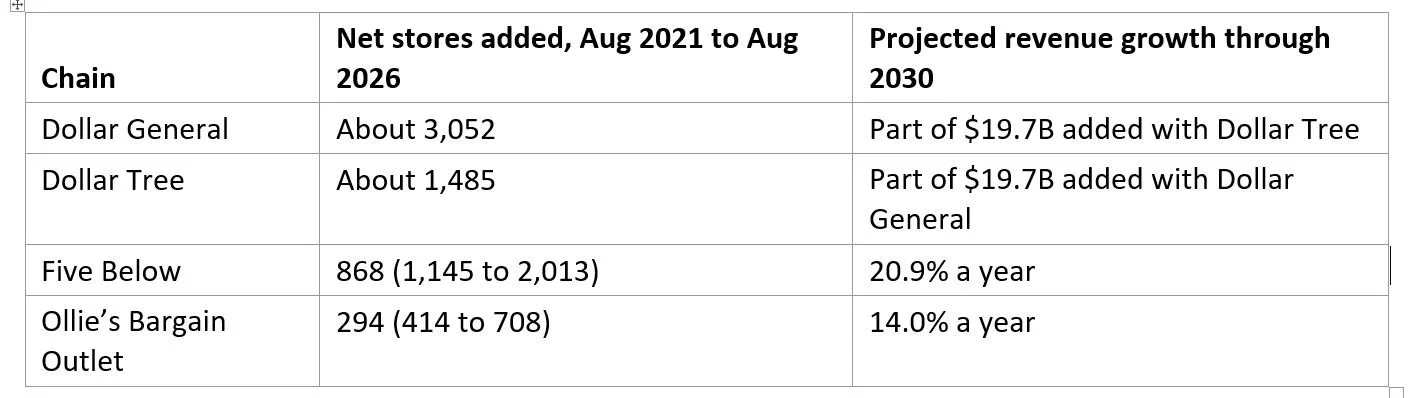
Think about that for a second. Dollar General and Dollar Tree together opened more than 4,500 net stores in five years. That’s nearly 2.5 new stores every single day, weekends included.
Coresight credits three things: low prices, convenient locations and the treasure-hunt experience. Two of those three are real estate decisions.
What I’ve Seen From the Tenant Side
Three points in the report line up with what I’ve watched happen across hundreds of site decisions.
1. Second-generation boxes are the new gold. Coresight expects discounters to chase second-generation boxes in infill locations. I’ve seen this firsthand. A dark junior anchor or former grocery box that sat empty for two years suddenly has three discount chains asking about it. Why? Speed and cost. A box that already has the parking, the loading and the zoning can open months sooner and for far less than ground-up construction. Every Big Lots, Joann and Party City closure didn’t just leave a hole. It created inventory for the next value retailer.
2. Secondary markets aren’t second-rate anymore. Rural towns, outer-ring suburbs and secondary centers are where much of this growth is headed. These are markets many national retailers ignored for years. The discounters didn’t. They go where the customer is underserved, the rent is reasonable, and the nearest competitor is a 20-minute drive away.
3. Co-tenancy is getting crowded. The report notes that Dollar General overlaps heavily with drugstores and grocers, while Five Below and Ollie’s sit near beauty, off-price and specialty retailers. That overlap cuts both ways. A discounter can be a great traffic driver for a center, or it can quietly pull sales from the tenants you already have. Landlords who don’t map those category overlaps before signing can create their own next vacancy.
Not Every Discounter Wins
The report is honest about the other side. Big Lots went bankrupt. Family Dollar has struggled. Rising costs, thin margins and brutal price competition are real. A low price on the shelf doesn’t fix a bad location, too many stores in the same trade area, or a format customers have stopped loving.
That’s the lesson I’d underline for landlords. The discount category is growing. That doesn’t mean every discount tenant is a safe bet for every box.
What Landlords Should Do Now
1. Know which discounter fits your box. Dollar General, Five Below and Ollie’s want very different sizes, trade areas and neighbors. Pitch the right one.
2. Underwrite the tenant, not just the category. Look at store density in the trade area and the chain’s recent closings, not just its national growth story.
3. Map the overlap before you sign. Know which existing tenants a new discounter will help, and which it will hurt.
4. Treat your dark boxes as an asset. A second-generation space in an infill market is exactly what these chains are hunting for. Price and position it that way.
The Bottom Line
Value isn’t a phase. Shoppers have learned they can find a deal and still enjoy the hunt, and the retailers giving them that experience are rewriting the map of where stores go. For landlords, the opportunity is real. So is the risk of picking the wrong partner.
Where are you seeing discounters show up in your markets? I’d love to hear what’s working and what isn’t.