
It Started With Lunch
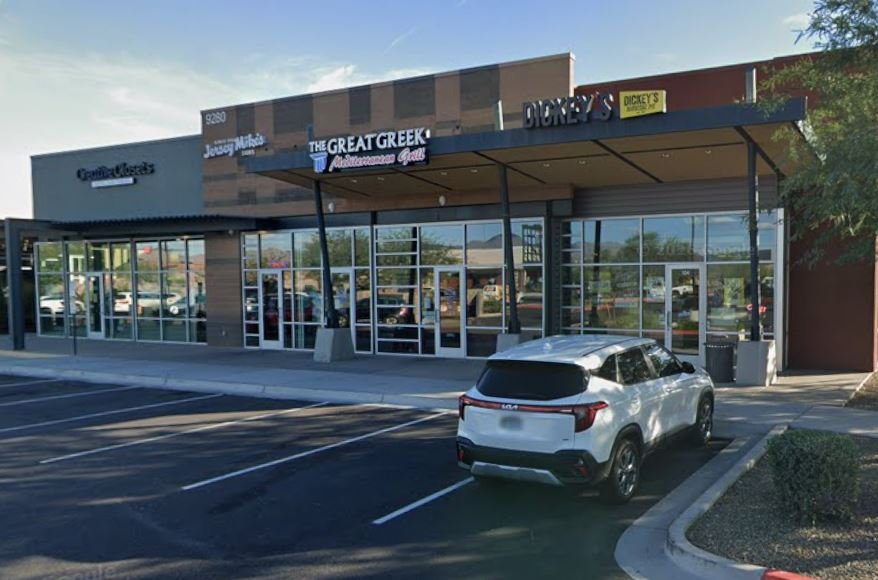
The Great Greek Mediterranean Grill
9280 East Vía de Ventura #103,
Scottsdale, AZ 85258
I'll start with a confession. I didn't find The Great Greek through a trade magazine. I found it the way most of their customers do: I was hungry in Scottsdale.
The restaurant on Vía de Ventura looked like a neighborhood spot. Bright, clean, a little coastal. I ordered the Great Greek Plate with a side salad, tzatziki, warm pita and rice pilaf, and I paid the extra $1.25 to swap in the feta fries. Best $1.25 I spent all week.
The food was fresh, the portions were generous, and the price was fair. I walked out a fan. My only complaint is that it isn't closer to my house.
What I didn't realize was how big this "neighborhood spot" has become. Then I read Abby Cox's November feature on the brand in Shopping Center Business. The Great Greek is a $100 million brand closing in on 100 locations, with restaurants in Australia, Egypt and Canada. Not bad for a concept that started when two neighbors in Las Vegas bought a 1,400-square-foot Greek restaurant in Henderson in 2016.
I've spent more than 40 years on the tenant side of retail real estate. So once I finished being impressed, I did what real estate people do. I started reading between the lines.
A Good Problem to Have
One line from Bob Andersen, the brand's president, stopped me cold: "We're only limited in our growth by the number of sites we can acquire now."
Read that again. Most restaurant brands would trade a lot to have that problem. Franchise demand is not The Great Greek's constraint. Real estate is.
The numbers back him up:
20 new restaurants opened in 2025
Franchise sales up 41% year over year
20 new domestic franchise agreements in the first half of 2026 alone, including four multi-unit deals for 30 future restaurants
On track to pass 100 open restaurants by the end of 2026, the brand's 15th anniversary
The pipeline runs from Nassau County to Dallas, Naples, Omaha, Sioux Falls, Charlotte, Bakersfield and a first deal in Massachusetts. That's a lot of trade areas to learn, a lot of landlords to meet, and a lot of franchisees who signed an agreement and now want a location.
I've lived this exact moment. When franchise sales outrun the site pipeline, the pressure doesn't go away. It moves. It lands on the real estate team, on the franchisees waiting for a site, and eventually on the quality of the deals that get signed.
Don't Wait for Inventory. Create It.
So how does a fast-growing brand find more sites when the good ones are scarce? Waiting for the perfect space to hit the market is not a strategy. Here are four things that have worked for the brands I've helped grow.
Plan with landlords, not just deal by deal. The best centers rarely come one LOI at a time. Brands that sit down once a year with a landlord's leasing team, share their target markets and commit to several openings tend to see space before it's listed. A handful of national owners control many of the centers on any brand's wish list.
Follow the anchors you already love. Andersen named Starbucks, Chipotle, Panera, Whole Foods, Sprouts and Costco as co-tenants that work. That list is a map. I spent eight years as the development leader at Sprouts Farmers Market and opened 239 stores. Every new Sprouts-anchored center comes with pads, endcaps and inline space that a brand like The Great Greek fits perfectly, and those centers are planned two to three years before they open.
Treat second-generation restaurant space as an asset. Closed restaurants with hoods, grease traps and patios are everywhere right now. The right one cuts months off an opening and hundreds of thousands off a buildout, which matters a lot to a first-time franchisee.
Use the flexible footprint as a door opener. A concept that works in 1,700 to 2,000 square feet, inside T-Mobile Arena and in a University of Michigan food hall can say yes to spaces other brands can't. That flexibility belongs at the front of every landlord conversation.
There's one more piece: a market plan ahead of the franchisee. When a new owner signs for Omaha or Bakersfield, they should already know which trade areas, centers and co-tenants the brand wants. That turns the search from "find me something" into "go get one of these three."
What I'd Watch
Growth this fast has one quiet risk. When franchisees are waiting and the pressure is on, it gets tempting to say yes to the B-minus site because it's available. One weak location costs a franchisee their savings, and it costs the brand a little of the reputation it spent 15 years building.
Andersen clearly knows this. He talked about wanting centers that are "prominent and high performing," and about being known by the company you keep. Holding that line at 30 or 40 openings a year is the hard part. It takes clear site criteria, honest rent-to-sales targets, and someone willing to walk away from a deal.
The Next 100
The first 100 restaurants are built on a great product and a lot of hustle. The next 100 are built on real estate planning. The Great Greek has the first part down. I know because I tasted it.
I'll be watching their growth with interest, and with a fork in hand. If you're in Scottsdale, go order the Great Greek Plate and spring for the feta fries. And Bob, if you're reading this, I'd love to see one a little closer to my side of town.
For those of you running a growing brand: what's the hardest part of finding sites in your markets right now?
Source: Abby Cox, "Beyond the Menu: The Great Greek's Recipe for the Right Site," Shopping Center Business, November 2026.